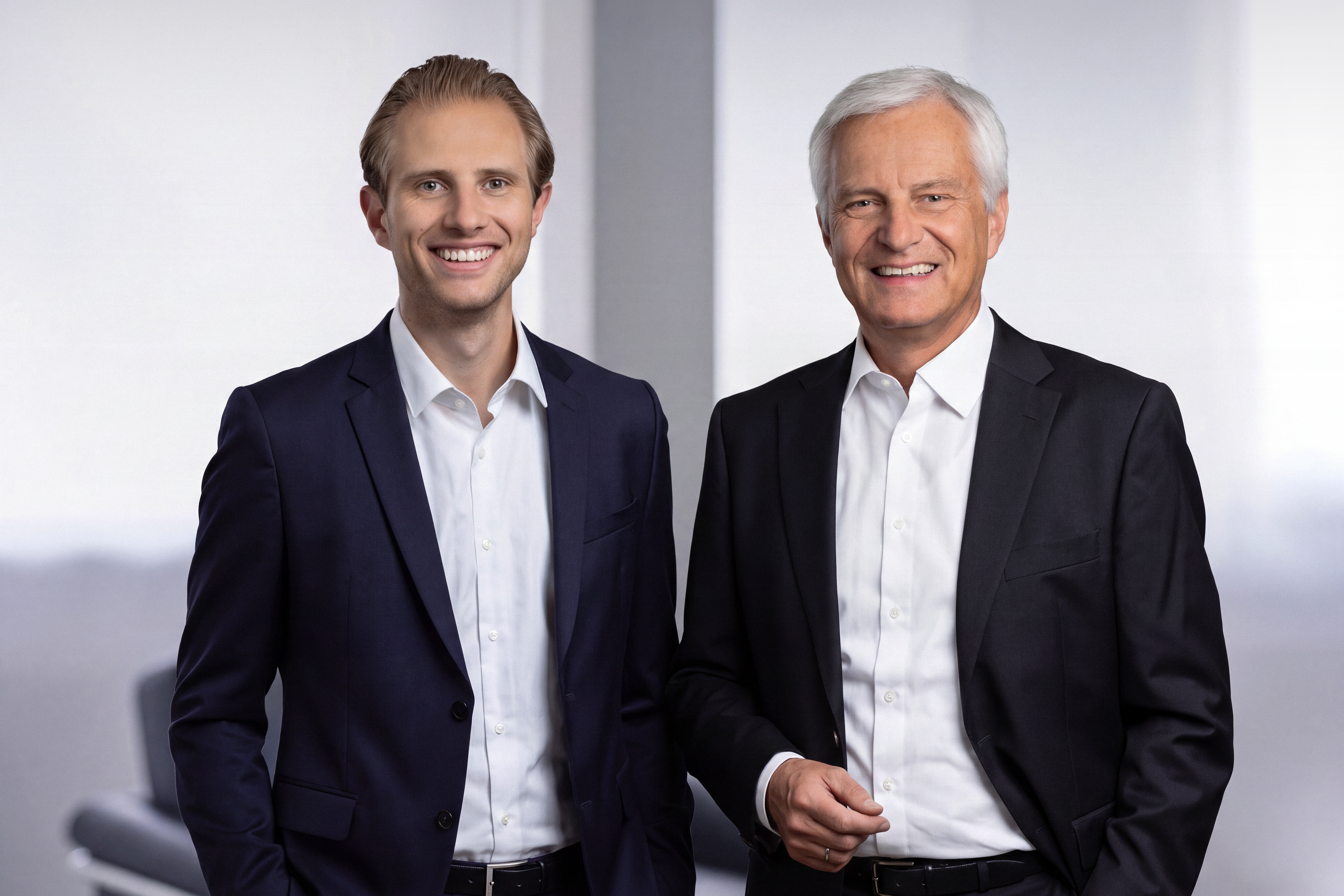
Forty years ago, Pirmin Hotz founded Dr. Pirmin Hotz Vermögensverwaltungen AG, now one of Switzerland’s leading independent wealth management firms. Today, his son Florian is gradually taking on greater responsibility for the business as the next generation steps forward. In this interview, Pirmin and Florian Hotz explain how they prepared for the transition over several years and the questions that arise when succession takes place within a family.
Start Early and Allow the Decision to Evolve
The right time to start thinking about succession is long before the planned handover. The first step is to address some fundamental questions: Should the business remain in the family? Is there someone with the right capabilities to lead it? And does that person genuinely want to take on the responsibility?
For Pirmin Hotz, these considerations began ten to fourteen years before the current transition phase. Two conditions were particularly important to him: the potential successor must have the necessary skills and must be willing to take on responsibility out of personal conviction. Florian Hotz therefore deliberately gained experience outside the family business, including in investment banking in London. Only then did he decide to join the company.
Truly Hand Over Responsibility
Succession can only succeed if responsibility is transferred in practice, not merely on paper. During the transition, it must be clear who makes which decisions and when the next generation will genuinely take over.
Pirmin and Florian Hotz have established a clear timeline for this process. At the same time, Pirmin has already handed over operational responsibilities.For other business owners, this raises important questions early on: Which decision-making powers should be transferred, and when? What role will the outgoing generation play afterwards? And how should differences of opinion be handled?
Pirmin Hotz sees the ability to let go as a decisive factor. If the founder continues to have the final say indefinitely, the next generation risks still being perceived as the ‘junior’ partner years after the handover.
Trust Is Built Through Communication
Succession within a family affects far more people than just the predecessor and successor. Family members, employees and clients need to understand how the transition is being managed and what the next generation stands for.
At Hotz, communication therefore began at an early stage. Clients were kept informed of developments, and Pirmin and Florian met with them together. Internally, too, both follow a clear principle: they may hold different opinions, but they present a united front externally.
Preserve What Works While Continuing to Evolve
With the arrival of the next generation comes the inevitable question of what should change and what should remain. For Pirmin and Florian, this is particularly evident in their investment philosophy. Fundamental principles such as long-term active investing, quality and the deliberate avoidance of concentration risks are to remain in place. At the same time, even an investment philosophy developed over decades must adapt to changing market conditions. For Florian, the aim is therefore not to reinvent what already exists, but to develop it further where it makes sense.
Questions from the Audience
Following the main interview, the audience raised several additional questions. Pirmin and Florian Hotz explored topics that had only been touched upon during the discussion: How is a young successor perceived by experienced clients? How will the investment philosophy evolve with the next generation? What advice would Pirmin like to give his son for the decades ahead? And what should other business owners consider when planning their own succession?
These additional questions highlight how successful succession requires several dimensions to come together. Professional expertise alone is not enough. The next generation must build trust while also being given the opportunity to assume genuine responsibility.
Pirmin’s personal message to his son also goes beyond succession planning itself: remain authentic, grounded and honest, keep clients at the centre of everything and rely on a strong team. At the same time, a business owner must accept that certain decisions ultimately have to be made alone.
Understand Succession as a Process
Business succession cannot be reduced to a single handover date. It begins with identifying the right person, continues through the gradual transfer of responsibility and requires careful consideration of the family, employees and clients. The next generation needs room to build trust and develop its own approach. And the previous generation must be willing to genuinely create that space.